
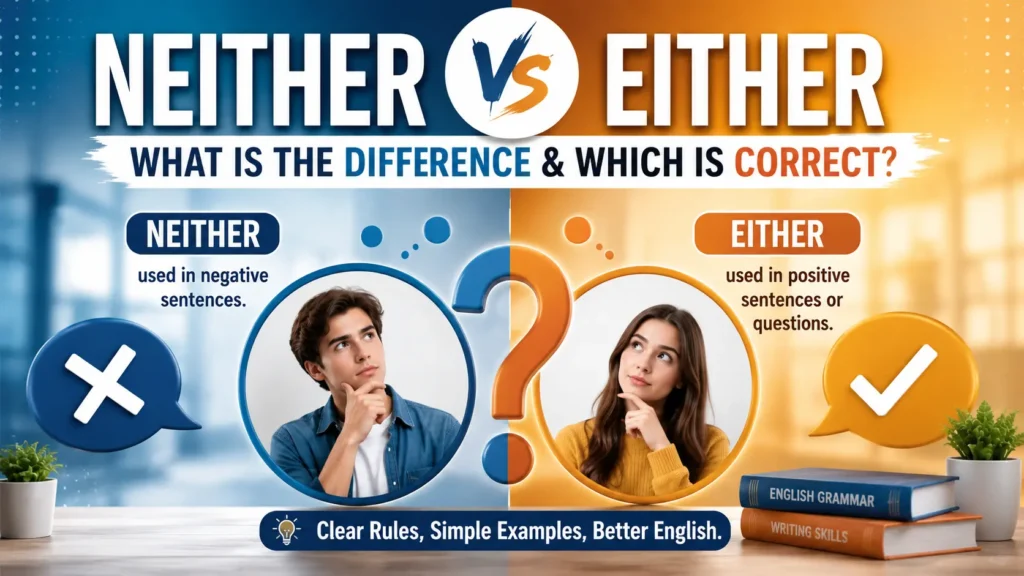

The words neither and either are common in English, but they often confuse learners because they are used in different types of sentences. While both usually refer to two choices, one expresses a negative meaning, and the other expresses a positive or alternative choice. Understanding the difference helps you write and speak English more accurately and naturally.
Comparison Overview
Both neither and either are used when talking about two people, things, or options. However, they have opposite meanings.
- Neither means not one and not the other.
- Either means one or the other.
These words can function as pronouns, determiners, conjunctions, and adverbs depending on the sentence.
| Feature | Neither | Either |
| Meaning | Not one and not the other | One or the other |
| Tone | Negative | Positive or Alternative |
| Usually Refers To | Two choices | Two choices |
| Part of Speech | Pronoun, Determiner, Conjunction, Adverb | Pronoun, Determiner, Conjunction, Adverb |
| Common Structure | Neither…nor | Either…or |
Definition of Neither
Neither means not one of two people or things. It expresses a negative idea without needing another negative word.
Examples:
- Neither answer is correct.
- Neither student passed the exam.
- Neither option seems suitable.
- Neither of the books belongs to me.
The word itself already carries a negative meaning.
Definition of Either
Either means one or the other of two choices. It expresses a choice or possibility.
Examples:
- Either answer is acceptable.
- You can choose either road.
- Either student may lead the project.
- Either option will work.
It often introduces alternatives.
Main Differences Between Neither and Either
| Aspect | Neither | Either |
| Meaning | Not one of two | One of two |
| Expresses | Negative | Positive choice |
| Common Pair | Neither…nor | Either…or |
| Used With Negatives | Yes | Usually No |
| Purpose | Rejects both options | Accepts one option |
Key Differences
- Neither rejects both choices.
- Either accepts one of two choices.
- Neither already has a negative meaning.
- Either introduces alternatives.
- Both usually refer to exactly two items.
Neither vs Either in Everyday English
These words appear frequently in daily conversations.
Examples:
- Neither movie was interesting.
- Either restaurant is fine.
- Neither of us knew the answer.
- Either of you can help me.
Choosing the correct word depends on whether you mean neither of the two or one of the two.
Comparison Table
| Situation | Best Choice |
| Rejecting both options | Neither |
| Choosing one option | Either |
| Giving alternatives | Either |
| Saying both are unsuitable | Neither |
| Offering a choice | Either |
| Expressing negative agreement | Neither |
| Expressing possibility between two options | Either |
Grammar Guide
Both neither and either can have several grammatical functions.
| Word | Parts of Speech |
| Neither | Pronoun, Determiner, Conjunction, Adverb |
| Either | Pronoun, Determiner, Conjunction, Adverb |
How Each Term Is Used in Sentences
Neither as a Determiner
Pattern:
Neither + singular noun
Examples:
- Neither answer is correct.
- Neither book is available.
- Neither player scored.
Neither as a Pronoun
Examples:
- Neither was selected.
- Neither of them agreed.
- Neither arrived on time.
Neither…Nor
Pattern:
Neither + noun + nor + noun
Examples:
- Neither Tom nor Jack came.
- Neither coffee nor tea is available.
- Neither rain nor snow stopped them.
Either as a Determiner
Pattern:
Either + singular noun
Examples:
- Either choice is acceptable.
- Either road leads home.
- Either answer works.
Either as a Pronoun
Examples:
- Either will do.
- Either is acceptable.
- You may choose either.
Either…Or
Pattern:
Either + noun + or + noun
Examples:
- Either Sarah or Emma will help.
- Either tea or coffee is available.
- Either bus will take you there.
Common Mistakes Learners Make
Mistake 1
Incorrect:
Neither of them aren’t coming.
Correct:
Neither of them is coming.
Mistake 2
Incorrect:
Either both students passed.
Correct:
Either student may participate.
Mistake 3
Incorrect:
Neither…or
Correct:
Neither…nor
Mistake 4
Incorrect:
Either…nor
Correct:
Either…or
Mistake 5
Using double negatives.
Incorrect:
I don’t want neither option.
Correct:
I want neither option.
or
I don’t want either option.
Simple Rules to Remember
- Neither means not one of the two.
- Either means one of the two.
- Use Neither…nor together.
- Use Either…or together.
- Avoid double negatives with neither.
Quick Tips for Writing and Speaking
- Use either when offering choices.
- Use neither when rejecting both options.
- Remember that neither already contains a negative meaning.
- Use singular verbs when the subject is singular.
- Match either with or, and neither with nor.
When to Use Each One
Use Neither When
- Rejecting two choices
- Saying no option is correct
- Expressing negative agreement
- Discussing two unsuitable alternatives
- Writing formal or informal English
Use Either When
- Offering two choices
- Giving alternatives
- Showing either option is acceptable
- Discussing two possibilities
- Writing positive statements
When NOT to Use Each One
Do Not Use Neither
- To mean one choice is acceptable.
- With another unnecessary negative word.
Incorrect:
I don’t like neither movie.
Correct:
I like neither movie.
or
I don’t like either movie.
Do Not Use Either
- When rejecting both choices.
- With nor.
Incorrect:
Either John nor Mike came.
Correct:
Either John or Mike came.
Which One to Use (Decision Guide)
Use this simple guide:
- Are both options unacceptable? → Neither
- Is one of two choices acceptable? → Either
- Are you making a negative statement? → Neither
- Are you offering alternatives? → Either
- Are you connecting two negative choices? → Neither…nor
- Are you connecting two possible choices? → Either…or
Real-World Practical Examples
Neither Examples
- Neither student completed the assignment.
- Neither answer is correct in the exam.
- Neither road leads to the village.
- Neither company accepted the proposal.
- Neither of the computers is working.
Either Examples
- Either route will get you there.
- You can choose either color.
- Either teacher can answer your question.
- Either solution will solve the problem.
- Either of the candidates is qualified.
Self-Assessment (Fill in the Blanks)
- I will use ______ when referring to two choices that are both unacceptable. The correct word is ______ because both options are rejected.
- I will use ______ when giving someone two acceptable options. The correct word is ______ because it expresses a choice.
- I will use ______ before “nor” in a sentence. The correct word is ______ because they are paired together.
- I will use ______ before “or” in a sentence. The correct word is ______ because they form the correct pair.
- I will use ______ when saying no answer is correct. The correct word is ______ because it has a negative meaning.
- I will use ______ when one of two roads may be taken. The correct word is ______ because either option works.
- I will use ______ when both candidates are unsuitable. The correct word is ______ because neither one is accepted.
- I will use ______ when offering two desserts. The correct word is ______ because the listener may choose one.
- I will use ______ when saying both books are unavailable. The correct word is ______ because both are rejected.
- I will use ______ when describing two possible solutions. The correct word is ______ because one choice is sufficient.
- I will use ______ when expressing negative agreement. The correct word is ______ because it means not one of the two.
- I will use ______ before the word “or.” The correct word is ______ because it introduces alternatives.
- I will use ______ before the word “nor.” The correct word is ______ because it introduces two rejected options.
- I will use ______ when one gift may be selected. The correct word is ______ because it indicates a choice.
- I will use ______ when both answers are wrong. The correct word is ______ because it rejects both.
- I will use ______ when either team can win. The correct word is ______ because one possibility is acceptable.
- I will use ______ when talking about two failed options. The correct word is ______ because both are negative.
- I will use ______ when allowing one of two volunteers to help. The correct word is ______ because it offers a choice.
- I will use ______ when saying two restaurants are both unsuitable. The correct word is ______ because both are rejected.
- I will use ______ when choosing between two equally good plans. The correct word is ______ because one option may be selected.
Answers
- Neither
- Either
- Neither
- Either
- Neither
- Either
- Neither
- Either
- Neither
- Either
- Neither
- Either
- Neither
- Either
- Neither
- Either
- Neither
- Either
- Neither
- Either
Conclusion
Understanding the difference between Neither Vs Either is an important step toward using English more accurately and confidently. Although both words refer to two people, things, or choices, they express opposite meanings. Neither is used when you want to reject both options, while either is used when one of the two options is possible, acceptable, or available. Learning this simple distinction helps you avoid common grammar mistakes, especially when using the pairs neither…nor and either…or. Whether you are writing an essay, having a conversation, preparing for an English exam, or communicating at work, choosing the correct word makes your message clearer and more natural. With regular practice and by remembering the grammar rules explained in this guide, you will find it much easier to decide when to use neither and when to use either. Mastering these commonly confused words will improve both your spoken and written English.
FAQs
What is the main difference between neither and either?
The main difference is that neither means not one and not the other, while either means one or the other. Neither expresses a negative meaning by rejecting both options, whereas either presents a choice between two possibilities. Choosing the correct word depends on whether you are accepting or rejecting the available options.
Can neither and either be used in the same sentence?
Yes, they can appear in the same sentence when they serve different grammatical purposes. However, they should not be used to express the same idea. Make sure neither is used with negative meanings, and either with choices, so the sentence remains clear and grammatically correct.
Should I use “neither” or “either” with “or”?
Use either with or because they form the correct grammatical pair. For example, either tea or coffee is available. The word neither should never be paired with or. Instead, it is correctly matched with nor to express a negative relationship.
Why is neither considered negative?
Neither already contains a negative meaning because it indicates that both options are rejected. Since the word itself is negative, you should avoid adding another negative word in the same sentence. This helps prevent the common mistake known as a double negative.
Can either mean both?
No. Either never means both. It refers to one of two choices, even if both options are acceptable. If you want to include both people or things, use words such as both or all, depending on the context.
Is it correct to say neither of them is?
Yes, neither of them is is grammatically correct because neither is generally treated as singular in standard English. Although informal speech may sometimes use a plural verb, singular agreement is preferred in formal writing and most grammar guides.
When should I use neither nor?
Use neither…nor when you want to say that two people, things, or ideas are both not true or not accepted. For example, Neither Jack nor Emma attended the meeting. This structure clearly rejects both alternatives in one sentence.
Can either be used as an adverb?
Yes. Either can function as an adverb, especially after a negative statement. For example, I don’t like coffee either. In this use, it means also not and agrees with the negative meaning of the sentence.
Is neither formal nor informal?
Neither is appropriate in both formal and informal English. It appears frequently in academic writing, business communication, newspapers, and everyday conversations. As long as it is used correctly, it sounds natural in almost every type of communication.
How can I remember the difference between neither and either?
A simple way to remember is that neither means none of the two, while either means one of the two. Also remember the matching pairs: neither…nor always go together, and either…or always go together. These easy rules make choosing the correct word much simpler.
