
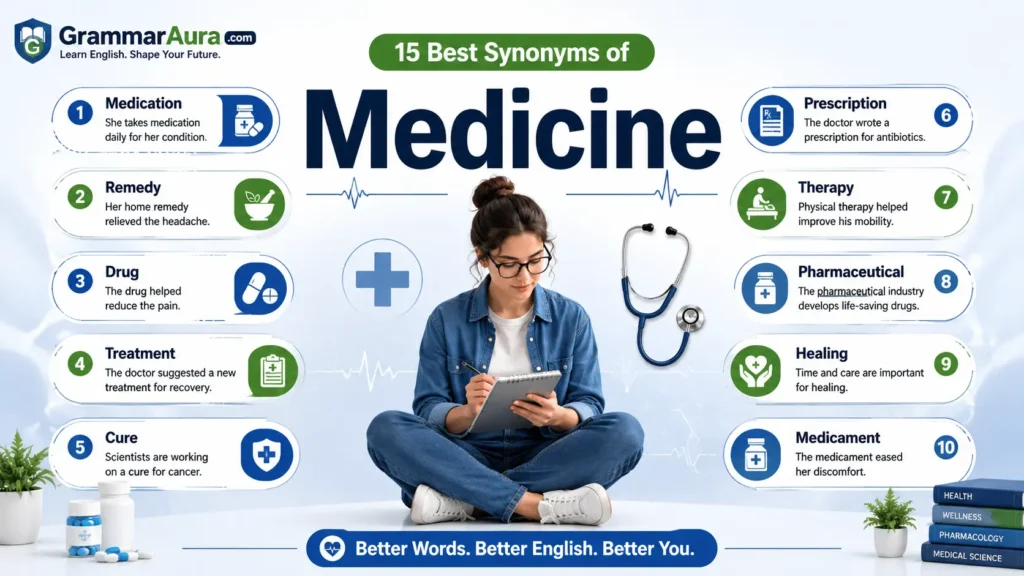

15 Best Synonyms of “Medicine” (With Examples) shows how choosing the right words can make communication feel more thoughtful and precise in real use. From my experience, medicine is a familiar, widely accepted term, but there are many situations where another expression may better match your audience, context, or tone.
When you’re writing about healthcare, discussing treatment options, or explaining a prescription, using an alternative can improve clarity and make your message more engaging. In real practice, I’ve noticed that small language changes can make communication feel more human and accurate, especially when using words in medical explanations where understanding matters. A simple alternative to medicine helps people receive information better, making healthcare writing easier to follow while staying respectful and clear.
What Does “Medicine” Mean?
Medicine refers to a substance or preparation used to prevent, treat, or relieve illness, pain, or disease. The term can also describe the broader science and practice of diagnosing, treating, and preventing health conditions.
In everyday conversation, people often use medicine to mean pills, syrups, injections, or other remedies prescribed by a healthcare professional or purchased over the counter.
When to Use “Medicine”
You should use “medicine” when referring to:
- Prescription drugs provided by a doctor.
- Over-the-counter treatments for common conditions.
- General discussions about healthcare and treatment.
- Educational or medical writing where a broad, familiar term is appropriate.
It works well in both casual and formal settings because most readers immediately understand its meaning.
Is It Professional or Polite to Say “Medicine”?
Yes. “Medicine” is both professional and polite. It is the standard term used by healthcare providers, educators, researchers, and the general public. Depending on the context, however, more specific words like medication, pharmaceutical, or drug may offer greater precision.
Pros and Cons of Using “Medicine”
Pros
- Universally understood
- Appropriate in formal and informal communication
- Simple and reader-friendly
- Broad enough to cover many types of treatments
Cons
- Can be too general in technical discussions.
- May lack specificity when distinguishing between prescriptions, supplements, or therapeutic compounds.
- Some professional contexts prefer more precise terminology.
Medicine synonyms:
- Medication
- Drug
- Remedy
- Treatment
- Pharmaceutical
- Cure
- Prescription
- Therapeutic
- Elixir
- Potion
- Physic
- Medicament
- Therapy
- Medicinal Product
- Healing Agent
Medication
Meaning:
A substance used to diagnose, treat, cure, or prevent disease.
Definition:
Medication is one of the closest and most professional alternatives to medicine, commonly referring to prescribed or recommended pharmaceutical products.
Explanation:
Healthcare professionals often use this term because it sounds more precise and clinical than medicine, especially in hospitals and pharmacies.
Example:
“The doctor adjusted my medication after reviewing the test results.”
Best Use:
Clinical reports, prescriptions, healthcare discussions, and patient education.
Worst Use:
Casual conversations where simpler wording may feel more natural for children or general audiences.
Tone:
Professional, precise, and neutral.
Drug
Meaning:
A chemical substance intended to affect the body’s functions.
Definition:
A drug is any substance used for treatment, prevention, diagnosis, or symptom relief.
Explanation:
Although commonly associated with pharmaceuticals, the word can also refer to recreational substances, so context is important.
Example:
“The new drug showed promising results during clinical trials.”
Best Use:
Scientific research, regulatory documents, and pharmaceutical discussions.
Worst Use:
Friendly conversations where the term might create unintended negative associations.
Tone:
Technical and scientific.
Remedy
Meaning:
Something that relieves or cures a disease or discomfort.
Definition:
A remedy often refers to a solution, treatment, or natural cure rather than a manufactured pharmaceutical.
Explanation:
The term frequently appears when discussing traditional practices, home treatments, or simple solutions for common ailments.
Example:
“Warm tea with honey is a popular home remedy for a sore throat.”
Best Use:
Wellness articles, home care advice, and traditional healing discussions.
Worst Use:
Situations requiring strict medical or regulatory terminology.
Tone:
Warm, comforting, and approachable.
Treatment
Meaning:
Care is provided to manage or cure an illness.
Definition:
Treatment refers to the overall process or method used to improve a patient’s condition, which may include medicine, therapy, or procedures.
Explanation:
Unlike medicine, this term encompasses a broader plan rather than a single substance.
Example:
“The patient’s treatment includes medication and physical therapy.”
Best Use:
Healthcare planning, patient discussions, and medical reports.
Worst Use:
When referring specifically to a pill or liquid medication.
Tone:
Professional and comprehensive.
Pharmaceutical
Meaning:
A medicinal product developed and manufactured for therapeutic use.
Definition:
Pharmaceutical typically refers to drugs or products produced by the pharmaceutical industry.
Explanation:
It emphasizes the commercial and scientific development of medical products rather than everyday usage.
Example:
“The company invested heavily in innovative pharmaceutical research.”
Best Use:
Industry reports, business writing, and regulatory contexts.
Worst Use:
Casual conversations where the wording may sound overly technical.
Tone:
Formal and industry-focused.
Cure
Meaning:
Something that eliminates a disease or condition.
Definition:
A cure is an intervention that permanently resolves an illness rather than simply managing symptoms.
Explanation:
Not every medicine is a cure, making this a more limited but powerful synonym in appropriate contexts.
Example:
“Researchers continue searching for a permanent cure.”
Best Use:
Discussions about disease eradication and successful recovery.
Worst Use:
Referring to treatments that only reduce symptoms.
Tone:
Hopeful and optimistic.
Prescription
Meaning:
A doctor’s authorized recommendation for medication.
Definition:
Although technically an order rather than the medicine itself, people often use the term ” prescription to refer to prescribed medication.
Explanation:
The term highlights physician oversight and regulated distribution.
Example:
“I picked up my prescription from the pharmacy.”
Best Use:
Healthcare administration and patient communication.
Worst Use:
Referring to non-prescribed supplements.
Tone:
Professional and practical.
Therapeutic
Meaning:
Intended to heal or provide medical benefit.
Definition:
Therapeutic often describes products or interventions designed to improve health outcomes.
Explanation:
It emphasizes beneficial effects rather than the product category.
Example:
“The cream has therapeutic properties that soothe irritated skin.”
Best Use:
Medical literature and product descriptions.
Worst Use:
Everyday conversations where a noun is expected.
Tone:
Clinical and descriptive.
Elixir
Meaning:
A medicinal liquid or restorative preparation.
Definition:
Traditionally, an elixir refers to a sweetened liquid medicine, though it may also be used figuratively.
Explanation:
The word often evokes historical or poetic imagery while still retaining pharmaceutical meaning.
Example:
“The pharmacist prepared an herbal elixir.”
Best Use:
Historical writing, literature, and specialty formulations.
Worst Use:
Modern technical medical documentation, unless describing an actual elixir formulation.
Tone:
Elegant and traditional.
Potion
Meaning:
A prepared liquid believed to have medicinal or magical effects.
Definition:
Historically, a potion could describe medicinal mixtures, though today it often carries fictional associations.
Explanation:
Modern audiences frequently connect this word with fantasy stories rather than healthcare.
Example:
“In folklore, healers brewed herbal potions.”
Best Use:
Creative writing and historical discussions.
Worst Use:
Professional healthcare communication.
Tone:
Imaginative and old-fashioned.
Physic
Meaning:
An archaic term for medicine or medical treatment.
Definition:
Historically used in English literature to describe healing substances.
Explanation:
The word is rarely used in modern speech but appears in classic texts.
Example:
“The ancient manuscript recommended a herbal physic.”
Best Use:
Historical or literary contexts.
Worst Use:
Contemporary medical communication.
Tone:
Classical and scholarly.
Medicament
Meaning:
A medicinal substance used for treatment.
Definition:
A formal synonym commonly found in scientific or pharmaceutical literature.
Explanation:
It emphasizes the therapeutic role of the substance.
Example:
“The topical medicament reduced inflammation.”
Best Use:
Academic and technical writing.
Worst Use:
Casual conversation.
Tone:
Highly formal.
Therapy
Meaning:
A method of treating illness or improving health.
Definition:
Therapy includes medications but also covers counseling, rehabilitation, and physical interventions.
Explanation:
It focuses on the treatment process rather than a specific product.
Example:
“Her recovery plan combined medicine with physical therapy.”
Best Use:
Comprehensive healthcare discussions.
Worst Use:
When referring only to a pill or capsule.
Tone:
Supportive and professional.
Medicinal Product
Meaning:
A regulated item intended for medical use.
Definition:
A broad legal and regulatory term encompassing approved healthcare products.
Explanation:
It often appears in government guidance and pharmaceutical regulations.
Example:
“The agency approved the new medicinal product.”
Best Use:
Compliance documents and regulatory writing.
Worst Use:
Informal speech.
Tone:
Official and regulatory.
Healing Agent
Meaning:
A substance that promotes recovery or healing.
Definition:
A descriptive phrase referring to anything that supports the body’s healing process.
Explanation:
It may include pharmaceuticals, natural compounds, or biologically active substances.
Example:
“Researchers identified a promising healing agent in the extract.”
Best Use:
Educational writing and broad health discussions.
Worst Use:
Legal pharmaceutical documentation requires precise terminology.
Tone:
Encouraging and informative.
Comparison Table of Top Alternatives
| Alternative | Best Use | Tone | Avoid When |
| Medication | Clinical discussions | Professional | Very casual speech |
| Drug | Scientific writing | Technical | Informal conversation without context |
| Remedy | Home care | Warm | Strict medical documentation |
| Treatment | Healthcare plans | Comprehensive | Referring to one pill |
| Pharmaceutical | Industry reports | Formal | Everyday conversation |
| Cure | Disease resolution | Hopeful | Symptom management only |
| Prescription | Doctor-issued medicine | Practical | Non-prescribed products |
| Therapeutic | Medical descriptions | Clinical | As a standalone noun |
| Elixir | Historical or literary contexts | Traditional | Modern technical writing |
| Potion | Creative writing | Imaginative | Professional healthcare |
| Physic | Historical literature | Classical | Contemporary usage |
| Medicament | Academic writing | Highly formal | Casual communication |
| Therapy | Holistic treatment | Supportive | Referring only to medication |
| Medicinal Product | Regulatory contexts | Official | Everyday speech |
| Healing Agent | Educational content | Informative | Legal pharmaceutical terminology |
Final Thoughts
Choosing the right synonym for “medicine” can make your writing and conversations more accurate, engaging, and meaningful. While medicine remains a trusted and widely recognized term, alternatives like medication, remedy, therapy, and treatment can better fit specific situations. Understanding the subtle differences between these words helps you communicate with clarity and confidence, whether you’re writing professionally or speaking casually.
The best choice ultimately depends on your audience and purpose. In medical settings, precise terms such as drug or medicament may be appropriate, while friendlier expressions like remedy or healing agent work well in everyday discussions. Expanding your vocabulary not only improves your communication skills but also ensures your message sounds thoughtful, natural, and easy to understand.
FAQs
What is the closest synonym for “medicine”?
The closest synonym for medicine is medication. Both words refer to substances used to prevent, treat, or manage illnesses and are often used interchangeably. However, medication tends to sound slightly more formal and is frequently preferred in healthcare settings, medical records, and professional communication where accuracy and precision are especially important.
Is “drug” the same as “medicine”?
Not exactly. A drug is any chemical substance that affects the body or mind, while medicine usually refers to a drug used specifically for treating or preventing illness. Although all medicines can be considered drugs, not every drug is used for medical purposes, making context essential when choosing between the two terms.
Can I use “remedy” instead of “medicine”?
Yes, remedies can replace medicine in many situations, especially when discussing natural treatments or home solutions. However, it often implies a broader or less formal approach and may not refer to regulated pharmaceutical products. In professional healthcare writing, medication or treatment is usually a more suitable choice.
Is “medication” more professional than “medicine”?
In many healthcare environments, medication is considered slightly more professional because it specifically refers to prescribed or therapeutic substances. Doctors, nurses, and pharmacists commonly use the term in clinical documentation. Nevertheless, medicine remains perfectly acceptable and professional in both everyday conversations and formal medical discussions.
What word should I use in scientific writing instead of “medicine”?
For scientific or research-based writing, terms such as drug, pharmaceutical, medicament, or medicinal product are often more precise. These alternatives align with technical terminology used in journals, regulatory documents, and pharmaceutical research while providing greater specificity than the broader term medicine.
Does “therapy” mean the same thing as “medicine”?
No. Therapy is a broader concept that includes various methods of treating a condition, such as counseling, physical rehabilitation, surgery, or medication. Medicine can be part of a therapy plan, but therapy itself is not limited to pharmaceutical products and may involve multiple forms of care working together.
When should I avoid using the word “potion”?
You should generally avoid potions in professional or medical contexts because it often suggests magical, fictional, or historical mixtures. While it may appear in literature or fantasy stories, using it in healthcare communication could confuse readers or make serious information seem less credible or accurate.
Is “cure” a synonym for “medicine”?
Only in certain contexts. A cure specifically refers to something that eliminates a disease or condition, whereas medicine may simply relieve symptoms or manage an illness. Many medicines help patients recover or feel better without providing a permanent cure, so the two terms should not always be used interchangeably.
Which synonym is best for everyday conversations?
For casual conversations, medicine, medication, and remedies are among the easiest and most natural choices. They are familiar to most people and clearly communicate the intended meaning without sounding overly technical. The best option depends on whether you’re discussing prescriptions, home care, or general health advice.
Why is it helpful to know different synonyms for “medicine”?
Learning different synonyms for medicine improves your vocabulary and helps you tailor your language to different audiences and situations. It allows you to write with greater precision, avoid unnecessary repetition, and choose words that match formal medical contexts, educational materials, or friendly everyday conversations while keeping your message clear and engaging.
